1. Research Background
Two-dimensional Ti₃C₂Tₓ MXene is a popular anode material for lithium-ion batteries. However, it suffers from issues such as easy stacking of layers, structural degradation, and low lithium adsorption and charge transfer efficiency, making it difficult to meet the high-capacity and long-cycle performance requirements of next-generation batteries.
Addressing these challenges, Professor Xu Junguo’s team from the College of Mechatronics and Control Engineering at Shenzhen University conducted in-depth research and published their latest findings in Advanced Composites and Hybrid Materials (Impact Factor: 21.8). They developed a novel Au-Ti₃C₂Tₓ-C (Au-TC) hybrid nanocomposite anode material. Through innovative strategies of interfacial coordination and structural regulation, they achieved comprehensive improvement in anode performance, providing a new material design concept for the development of high-capacity lithium-ion batteries.
2. Core Research Achievements
(1) Construction of a polarized host interface to break through the lithium adsorption and transport bottleneck: By utilizing the work function difference between Au QDs and Ti₃C₂Tₓ to form a polarized interface, electron-deficient nanobags are induced, significantly improving lithium adsorption and charge/ion transport efficiency.
(2) Multi-structure synergistic modification to enhance material structural stability: Au QDs anchoring inhibits MXene layer stacking, while composite biomass porous carbon strengthens structural stability, constructing a multi-mechanism synergistic system.
(3) Dual theoretical and experimental validation for precise regulation of electrochemical performance: The lithium storage mechanism is revealed through DFT calculations, combined with characterization tests to verify material performance, achieving a high degree of consistency between theory and experiment.
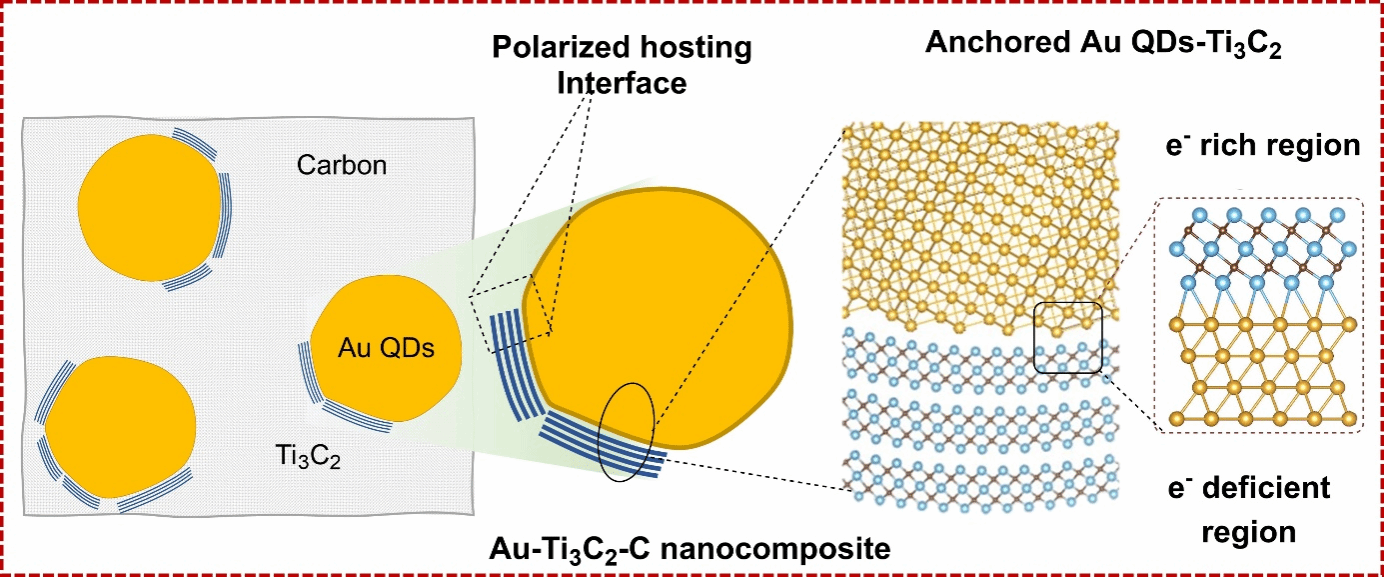
Figure 1. Schematic diagram of the Au-Ti polarized host interface and the electron-deficient nanobag structure
3. Application Value
The Au-TC composite anode material exhibits excellent electrochemical performance. It maintains a high specific capacity of 465 mAh g⁻¹ after 400 cycles at a current density of 0.1 A g⁻¹, with a lithium-ion diffusion coefficient of 4.72×10⁻¹¹ cm²/s, and demonstrates good thermal stability at high temperatures. It holds core application potential in multiple fields:
1. Development of miniature lithium-ion batteries: Suitable for biomedical implants, micro-sensors, and other miniature electronic devices, providing high volumetric energy density and long cycle life under special operating conditions;
2. Manufacturing of high-rate energy storage devices: The high ion diffusion coefficient meets fast-charging requirements and supports the upgrading of fast-charging products such as portable electronic devices and power tools;
3. Development of high-performance power batteries: The high capacity and high stability offer new material options for increasing battery capacity and optimizing safety performance.
Paper Link: https://doi.org/10.1007/s42114-026-01677-y
Prepared by: Ren Luyang
Typeset by: Chen Shifa
First Review and Proofreading: Ren Luyang
Second Review and Proofreading: Ma Jiang
Third Review and Proofreading: Zheng Chun