Recently, Wu Boyang, a 2022 undergraduate student from our college and a member of the Zhen Gong Innovation Party Branch, published a research paper as the sole first author in SCIENCE CHINA Materials, a journal under China’s Science and Technology Journal Excellence Action Plan and ranked in the top tier (Zone 1) of the Chinese Academy of Sciences, titled “Ultrasonic vibration enabled cold manufacturing of high thermal conductive Cu/Diamond composites”. The publication of this paper marks a new achievement in the quality of undergraduate cultivation in our college and fully demonstrates the remarkable effectiveness of our college in innovative talent training. In the future, the college will continue to implement the fundamental task of fostering virtue and educating people, deepen the reform of talent cultivation models, promote more undergraduates to enter laboratories, research teams, and projects at an early stage, and vigorously cultivate top talents with innovative spirit and practical abilities.
Paper Abstract:
1. Research Background
With the rapid development of electronic components toward high integration and high performance, higher requirements have been placed on heat dissipation materials, manifested in the pursuit of higher thermal conductivity and lower thermal expansion coefficient. The demand for copper/diamond composites, which combine excellent thermal conductivity and processability, has surged; however, their production is limited by stringent preparation conditions such as high temperature and high pressure, as well as complex intermediate medium coatings.
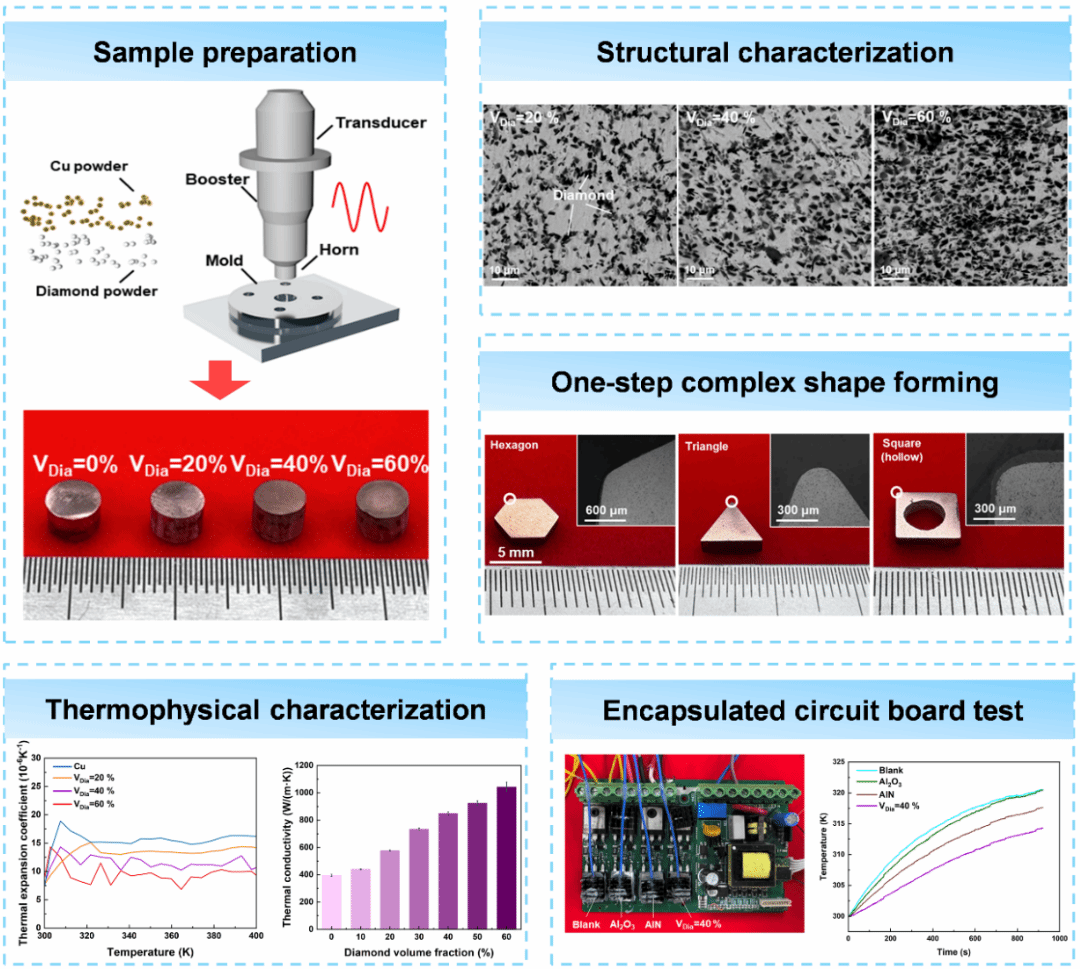
Addressing these challenges, Professor Ma Jiang’s team from the College of Mechatronics and Control Engineering at Shenzhen University proposed a one-step, heat-source-free cold manufacturing method, enabling the preparation of copper/diamond composites within seconds under room temperature and low pressure of 16 MPa via ultrasonic vibration. Compared to the commonly used high-temperature high-pressure sintering (HTHP) method, this approach reduces pressure by 200–500 times and temperature to only 20% of traditional methods. Leveraging this technology, direct metallurgical bonding between copper particle interfaces and solid embedding of diamond in the copper matrix were achieved, endowing the composite with a high yield strength of 150 MPa and an ultra-high thermal conductivity exceeding 1043 W/(m·K). In addition, this method enables easy fabrication of copper/diamond composites with various complex shapes. Heat dissipation application tests demonstrate that its thermal management performance surpasses that of commercial Al₂O₃ and AlN materials.
2. Research Methods
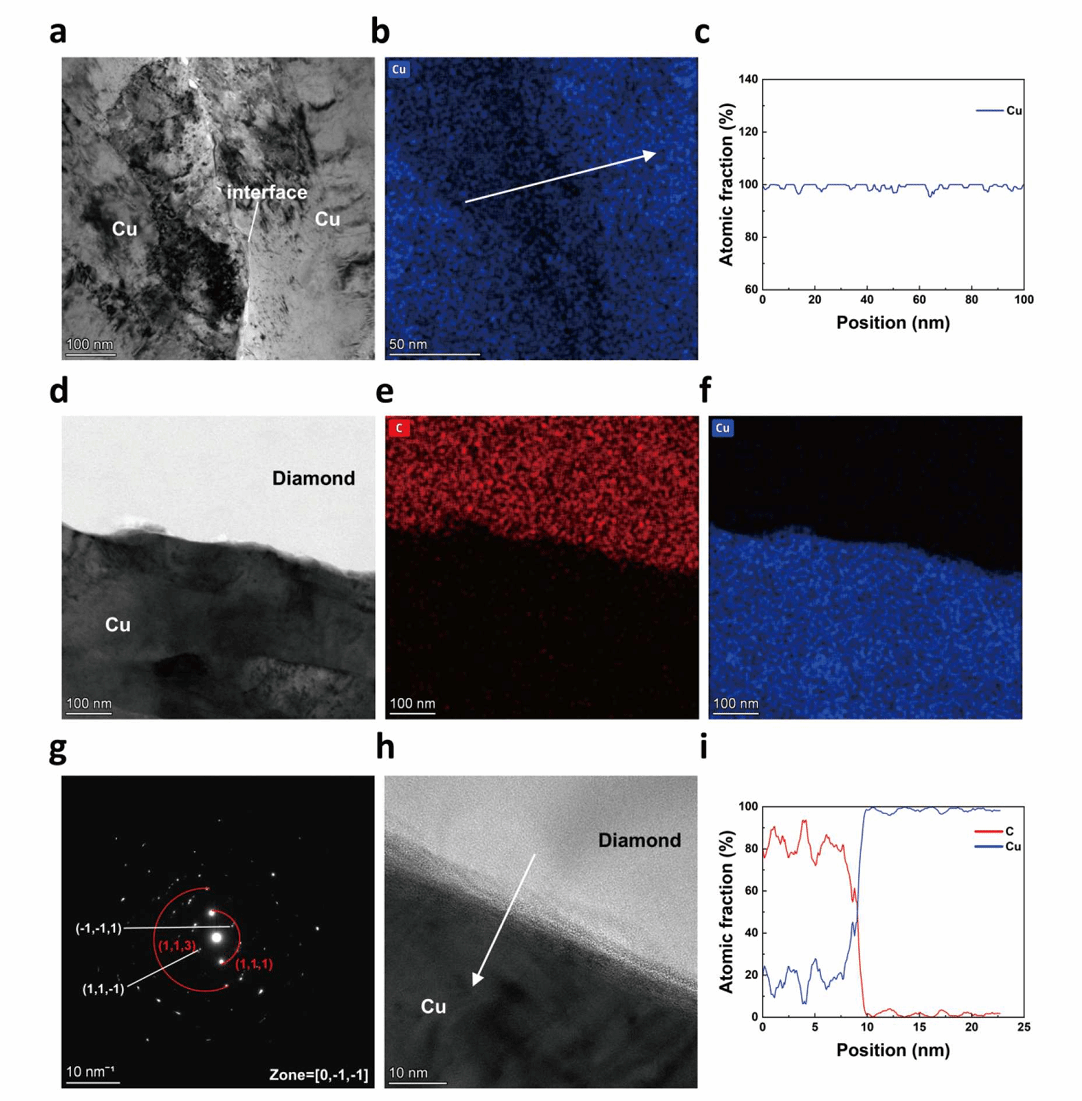
Ultrasonic vibration cold manufacturing equipment was used to prepare the composites, with process parameters optimized via the controlled single-variable method. SEM and CT were employed to observe microstructure; TEM and EDS were used to analyze interface bonding quality; thermophysical properties such as thermal conductivity, thermal expansion coefficient, and electrical conductivity were tested, while mechanical properties were evaluated through compression and hardness tests. Combining plastic deformation and atomic diffusion theories, the mechanism of ultrasonic vibration was analyzed, a theoretical model of solid-state composite under multi-field coupling was established, and the Maxwell-Eucken model was used to estimate the thermal conductivity of copper/diamond composites. Efficiency and performance were compared between traditional preparation methods and ultrasonic cold manufacturing to validate the advantages of the latter.
3. Core Research Achievements
(1) Proposed a novel ultrasonic vibration cold manufacturing technology to achieve one-step room-temperature low-pressure forming of copper/diamond composites without intermediate media, significantly reducing preparation difficulty and energy consumption;
(2) Addressed the poor wettability between copper and diamond, achieving a maximum diamond volume fraction of 60% in the composite, thermal conductivity exceeding 1043 W/(m·K), and combining high mechanical properties with low expansion characteristics;
(3) The material enables one-step forming of complex structures, with heat dissipation performance superior to commercial Al₂O₃ and AlN materials, validating its value in electronic thermal management applications.
Article Link: https://doi.org/10.1007/s40843-025-4028-5
Prepared by: Zhuo Yongjiu
Typeset by: Chen Shifa
First Review and Proofreading: Zhuo Yongjiu
Second Review and Proofreading: Lou Yan, Ma Jiang
Third Review and Proofreading: Zheng Chun