Professor Hao Wang's Team Publishes Major Review in Advanced Materials, Revealing How Noncondensable Gases Affect Solar-Driven Interfacial Evaporation
Recently, Professor Hao Wang of the College of Mechatronics and Control Engineering at Shenzhen University, serving as the first corresponding author, collaborated with first author Dr. Muhammad Sultan Irshad—formerly a postdoctoral researcher in Professor Wang's group and now an assistant professor at the School of New Energy and Electrical Engineering, Hubei University—to publish a major review titled “Impact of Noncondensable Gases on Solar-Driven Evaporation” in the leading international journal Advanced Materials (impact factor: 27.4). The review systematically explains how noncondensable gases (NCGs) affect the performance of solar-driven interfacial evaporation (SDIE) and provides key theoretical guidance for designing the next generation of efficient and stable solar-powered freshwater production systems.
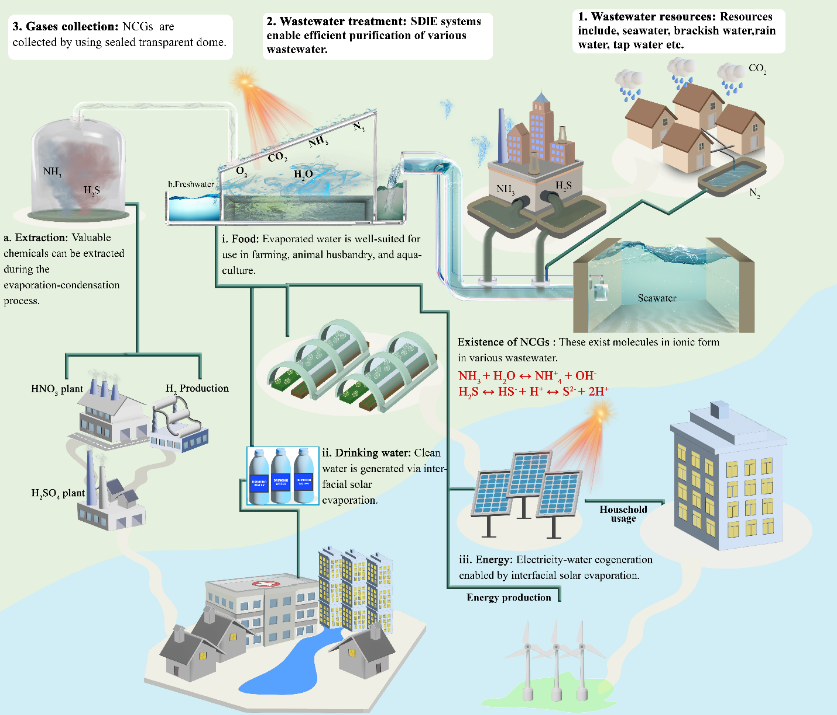
A Panoramic View: Integrated Water-Energy-Resource Co-production SystemFigure 1 of the paper presents a schematic of a multifunctional SDIE system. The system can treat wastewater from domestic, industrial, and seawater-related sources. As solar energy heats interfacial water to generate water vapor, gaseous by-products such as NH₃ and H₂S, together with noncondensable gases, are also released. Before condensation, these gases are routed to a gas-collection unit for selective separation. The recovered gases can then be utilized as resources: NH₃ for nitric acid synthesis, H₂S for sulfuric acid production, and H₂ as a clean energy source. Meanwhile, the purified water vapor proceeds to the condenser, where freshwater is collected. The system can also integrate photovoltaic panels and wind turbines for off-grid operation and combined heat and power generation, making it applicable to land-based and offshore agricultural irrigation, marine ranching, and other scenarios. This panoramic concept shows that noncondensable gases are not merely a nuisance; when properly managed, they can also be transformed into valuable resources.
Research Background: Opportunities and Challenges in Solar-Driven Interfacial Evaporation
Solar-driven interfacial evaporation (SDIE) uses photothermal materials to localize solar energy at the air-water interface, enabling efficient water evaporation. It is regarded as a highly promising green and low-carbon technology for addressing global freshwater scarcity. In recent years, rapid advances in photothermal materials—including carbon black, graphene oxide, carbon nanotubes, metal nanoparticles, metal-organic frameworks (MOFs), and conductive polymers—have increased SDIE evaporation rates from approximately 1 kg·m⁻²·h⁻¹ to more than 4 kg·m⁻²·h⁻¹, with solar-to-vapor conversion efficiencies exceeding 90% under controlled conditions.
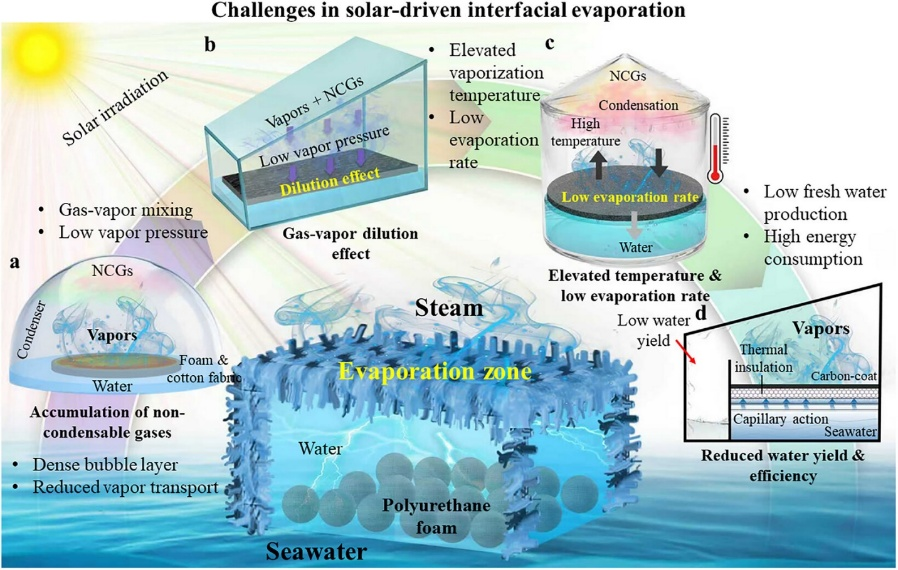
However, as system performance approaches its theoretical limit, the accumulation of noncondensable gases such as nitrogen, oxygen, and carbon dioxide is emerging as a key bottleneck that limits the practical deployment of SDIE technology.
Key Findings: How Do NCGs Reduce Efficiency?
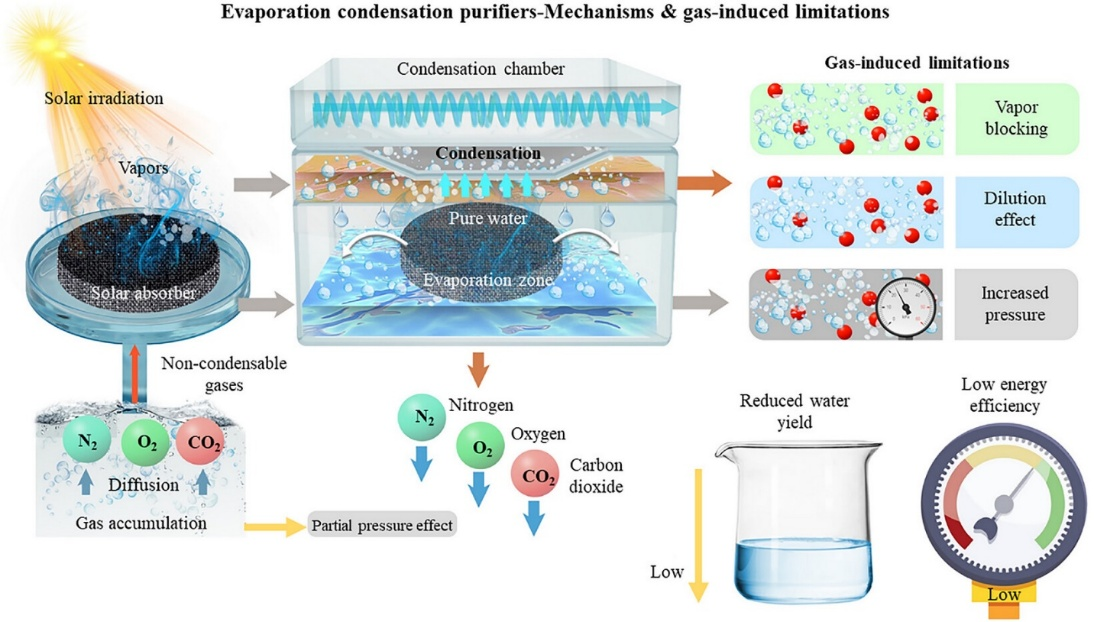
The research team systematically identified three major mechanisms through which noncondensable gases affect SDIE performance:
1. Mass-Transfer Barrier: Suppression of Vapor Diffusion
NCGs accumulate at the liquid-gas interface and form a diffusion-dominated boundary layer, forcing water vapor to diffuse through a “stagnant gas layer” rather than condense directly. Studies show that as little as 1%–2% air by volume can reduce the condensation heat-transfer coefficient by more than 50%. When the NCG mass fraction increases from 2% to 8%, the overall heat-transfer coefficient decreases by approximately 50%.
2. Dilution Effect: Reduction in Vapor Partial Pressure
According to Dalton's law of partial pressures, NCGs occupy part of the system's total pressure, reducing the effective partial pressure of water vapor and thereby weakening the driving force for condensation. Experiments have shown that removing NCGs, for example by applying a vacuum, can increase vapor flux by more than threefold.
3. Thermal Insulation Effect: Increased Thermal Resistance
The insulating layer formed by NCGs at the condensation interface impedes heat transfer to the cold wall, causing local temperatures to rise and the evaporation driving force to decrease. This creates a self-reinforcing cycle of “slower evaporation → insufficient condensation → further NCG enrichment.”
Mitigation Strategies: A Multi-Level Approach
The paper systematically summarizes a range of mitigation strategies, together with their mechanisms and reported effects:
Vacuum degassing: Reduces the total NCG content in the system and can restore up to 40% of efficiency in geothermal systems.
Hydrophobic gas-permeable membranes: Provide preferential pathways for gas escape, reduce the effective boundary-layer thickness, and significantly improve stability during continuous operation.
Optimized condenser geometry (e.g., perforated plates): Redistributes NCG accumulation zones and prevents localized blockage, improving heat transfer by up to 87.8% in multichannel condensers.
Inlet-humidity control and preheating: Reduce the initial NCG mass fraction and increase the interfacial vapor mass fraction. Every 10% increase in relative humidity can yield a 15%–25% efficiency gain.
Intermittent purge cycles: Periodically remove accumulated NCGs, reset the diffusion boundary layer, and maintain stable condensation performance under variable-load conditions.
The paper emphasizes that no single strategy can resolve all NCG-related issues. Future systems should therefore adopt hybrid approaches, such as combining passive ventilation with intermittent vacuum purging or integrating membrane separation with optimized chamber design.
Academic Significance and Future Directions
Drawing on kinetic theory, boundary-layer analysis, and diffusion-controlled mass transfer, the review establishes a unified theoretical framework for understanding NCG effects. It also proposes standardized methods for reporting NCG concentrations and protocols for anti-fogging performance testing, laying a foundation for cross-study comparison and technology translation in the field.
Professor Hao Wang's team identifies the following priorities for future research:
Advanced diagnostics and modeling: Develop real-time, high-spatial-resolution techniques for measuring NCG concentration and bubble dynamics, such as micro-optodes and synchrotron X-ray imaging combined with computational fluid dynamics (CFD).
Application-specific materials design: Develop membranes and evaporator structures that can actively manage NCGs while maintaining selective ion transport, drawing inspiration from adaptive gas-exchange designs in natural systems such as plant stomata.
Multi-process integration: Couple NCG management with functions such as photocatalytic pollutant degradation and hydrogen production, enabling a shift from “waste gas” to “resource.”
Life-cycle and economic assessment: Balance energy penalties, material costs, and operational complexity to provide decision-making support for different application scenarios.
About the Authors
The paper was co-authored by researchers from China, Pakistan, the United Arab Emirates, and Vietnam. First author Dr. Muhammad Sultan Irshad conducted postdoctoral research in Professor Hao Wang's group from 2022 to 2024 and is now an assistant professor at the School of New Energy and Electrical Engineering, Hubei University. Their previous collaborative work in this field includes: Small, 2026, 22(10), 2506124; Advanced Functional Materials, 2025, 35(44), 2509989; Chemical Engineering Journal, 2024, 500, 157068; Chemical Engineering Journal, 2023, 475, 146200; and Advanced Functional Materials, 2023, 2304936.
Researchers from Hubei University, the University of Wah in Pakistan, Abu Dhabi University in the United Arab Emirates, Xinjiang Institute of Engineering, Southeast University, and Phenikaa University in Vietnam also contributed to the work, underscoring the importance of global collaboration in sustainable water-energy-resource co-production technologies.
Paper: Irshad, M. S., Shakoor, B., Arshad, N., Ahmed, I., Fan, X., Li, W., ... & Wang, X. (2026). Impact of Noncondensable Gases on Solar-Driven Evaporation. Advanced Materials. DOI: 10.1002/adma.73586
Written by: Hao Wang
Typeset by: Shifa Chen
First Review and Proofreading: Luyang Ren
Second Review and Proofreading: Jiang Ma
Third Review and Proofreading: Chun Zheng