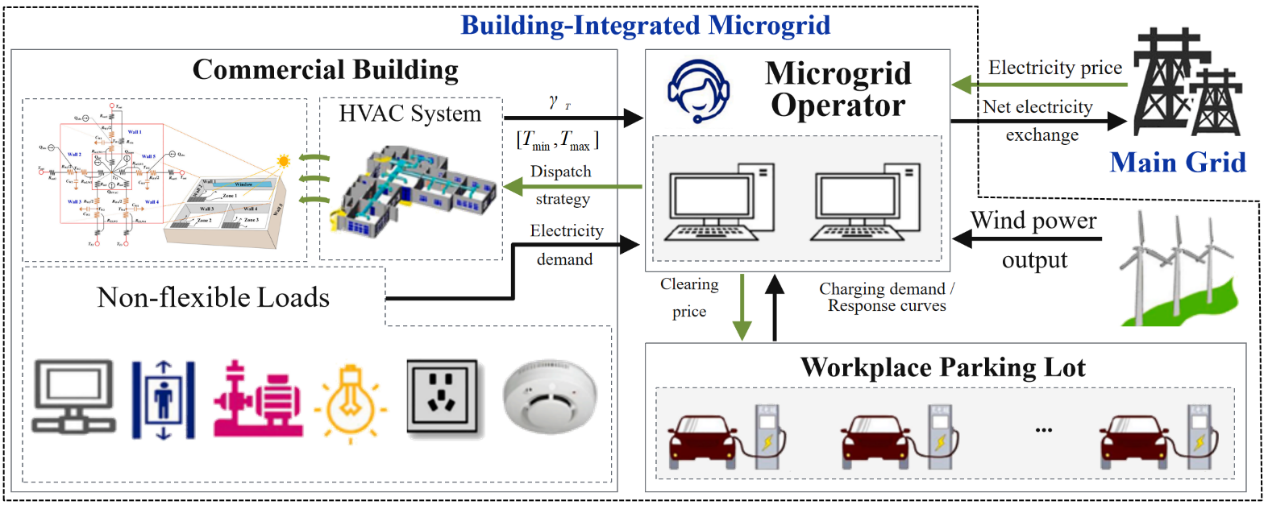
Figure 1. Schematic of the Building-Integrated Microgrid System
Research Highlights:
[Research Background] Renewable energy generation such as wind power in microgrids is intermittent and volatile, while electric vehicle (EV) charging behavior is also difficult to predict accurately. These two sources of uncertainty pose challenges to the economical and stable operation of microgrids. Most existing studies on microgrid energy management schedule only a single flexible resource, such as EVs or heating, ventilation, and air-conditioning (HVAC) systems. In addition, many EV demand-response mechanisms require vehicle owners to submit parameters such as response rates for each time period, creating a high participation barrier and raising privacy concerns that limit practical application.
[Researchers and Research Content] A team led by Research Fellow Guibin Wang of the College of Mechatronics and Control Engineering, Shenzhen University, proposed a two-stage optimal energy-management framework for a building-integrated microgrid (BIMG). The microgrid operator (MGO) establishes a transactive energy market for EVs in a workplace parking lot. EV owners need only set a single parameter—the EV emergency-use probability—upon arrival to participate in demand response, without providing any additional private information; the system then automatically generates response curves based on battery state of charge. The team also developed an R-C thermodynamic model of a commercial building to characterize the power demand of its heating, ventilation, and air-conditioning (HVAC) system. At the day-ahead stage, DBSCAN clustering is used to generate wind-power scenarios and represent wind-power uncertainty. At the intraday stage, model predictive control is used for rolling scheduling to coordinate the two flexible resources—HVAC systems and EVs—maximizing the MGO’s operating profit while maintaining occupants’ thermal comfort and meeting EV owners’ charging requirements, while also limiting deviations in net electricity exchange from the day-ahead schedule. The framework was validated using a BIMG consisting of a workplace parking lot with 450 EV charging piles, a commercial building with a 550 kW HVAC system, and an 800 kW wind power plant. Compared with the uncontrolled, HVAC system control-based, and EV charging control-based schemes, the MGO’s total profit increased by 256.8%, 34.1%, and 25.8%, respectively. The system remained profitable even when the wind-power forecast error, measured by mean absolute percentage error, reached 70%.
[Research Significance] The study provides a practical framework for microgrid operators to coordinate multiple flexible resources while addressing uncertainties in both renewable-energy output and user behavior. The proposed single-parameter, privacy-preserving EV response mechanism lowers the barrier for vehicle owners to participate in demand response and provides a useful reference for improving microgrid operating economics and the integration of renewable energy.
Written by: Guibin Wang
Typeset by: Shifa Chen
First Review and Proofreading: Luyang Ren
Second Review and Proofreading: Jiang Ma
Third Review and Proofreading: Chun Zheng